

Three Reasons Why Changing Grid Physics Require Dedicated Teleprotection Communications
Phoenix, AZ – April 24, 2026
The continued evolution of the grid has created challenges related to communication infrastructure which could not have been conceived of a decade ago. At the heart of those challenges is speed. Whereas in the past, grid engineers had time to physically act, the grid disturbances of today now propagate over large geographies in seconds, far beyond the realm of human control.
.png)
April 2025 - A Cautionary Tale
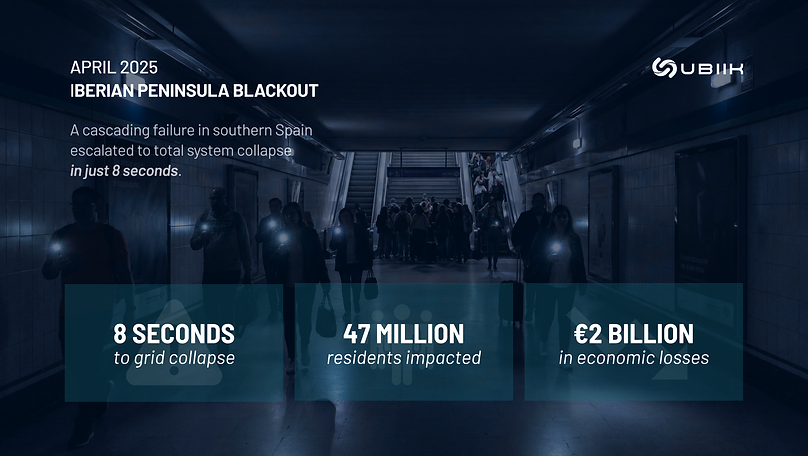
The April 2025 Iberian Peninsula blackout provides us with a cautionary tale, illustrating how protection and control systems must now coordinate at speeds that render human intervention impossible. Reaching total collapse within 8 seconds, this blackout is the bellwether for future grid disturbances. (Download a full analysis of this event and other recent blackouts HERE)
In the Iberian Peninsula situation, the collapse sequence began in southern Spain with a series of generation trips totalling 2,200MW. A mere 8 seconds later, the whole Iberian Peninsula grid system collapsed, impacting 47 million residents and resulting in estimated economic losses upwards of €2 billion.
So, what has changed in today’s grid?
These changing grid physics can be attributed to three key aspects:
Reduced system inertia
Grid of the past used more synchronous generation, involving rotational mass that previously dampened frequency excursions and giving engineers time to respond. Today’s grid incorporates more inverter-based resources (IBRs) which significantly impacts system inertia.
Wider interconnection coupling
Grid disturbances of today now propagate at near-real time speeds across large, interconnected geographic areas. The fact the April 2025 blackout started in Spain yet within seconds encompassed the entire Iberian Peninsula provides the perfect case study for this phenomenon.
Faster inverter response
solar and battery inverters react in milliseconds, introducing tighter control loops that interact across networks, beyond human reaction speed.
require rapid control
allows faster propagation
allows faster propagation
What does this mean in practical terms for utility communications?
When designing and deploying communication networks, utilities have traditionally ensured they can answer the following three questions:
-
Will the network give us the system availability we require?
-
Do we have coverage across our entire service territory?
-
Is there enough bandwidth to support all our use cases?
While these three primary metrics remain critical across most utility use cases, they are not sufficient when it comes to modern Teleprotection requirements. In addition to being a time-critical use case, Teleprotection also has one dominant parameter which separates it from the rest of a utility’s communications needs: timing consistency. Designing a utility communications network which meets availability, coverage and bandwidth requirements but misses this vital parameter for Teleprotection increases the likelihood of future grid collapses.
Understanding the impact of Jitter
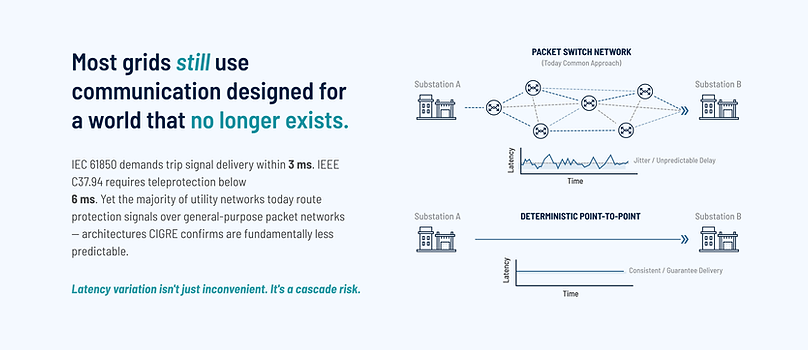
Most utility engineers understand the importance of latency (the average time for a message to get from point A to point B) but, when it comes to Teleprotection, an equally critical parameter is jitter. In simplistic terms, jitter is the variability of latency across successive messages in a network and, in addition to requiring speed, Teleprotection communications require stability in this timing. Even just a tiny variation in latency can have a massive impact, misaligning control actions which can ultimately (and within only a matter of seconds) descend into a full grid collapse.
When designing a communications network, it is important to keep in mind that a communications network can meet average latency targets yet still fail to coordinate, causing a blackout. What is required is for signals to arrive both rapidly AND coherently…and that last part is all about stable jitter.
.png)
Which communications architecture for which use case?
The best utility communications networks are obviously fit-for-purpose with each use case supported by the most appropriate technology/architecture. The table below outlines latency and jitter requirements for several grid functions:
Grid Use Case | Latency Target | Jitter Requirements | Sey Metric for Success |
|---|---|---|---|
Monitoring / metering | < 10 ms | Not Applicable | Service Territory Coverage |
SCADA / control | < 100 ms | Not critical | High availability % |
Distribution automation / DER | < 500 ms | Statistical | Ability to meet statistical average |
Transmission Protection | Delay-tolerant | < 1 ms | Worst case scenario performance |
When it comes to Teleprotection, only two technologies exist which can reliably meet the deterministic, sub 10ms latency required – fiber and sub 1 GHz licensed narrowband radio.
Dedicated fiber
Provides the lowest achievable latency, commonly used by utilities where terrain, right-of-way and budget permits.
Sub 1 GHz Licensed narrowband radio
Deterministic performance as spectrum and infrastructure are dedicated exclusively to teleprotection, suitable for difficult terrain, performs well through weather events compared to GHz spectrum, is impervious to ground movement from earthquakes and flooding, unlike fiber.
A blueprint for Utility Telecommunication Engineers
So now that we understand what has changed in grid physics dynamics plus the critical component of latency and stable jitter,
what are the key steps required to design resilient grid communications?
DETERMINISTIC LATENCY – the network must be guaranteed to support worst-case latency scenarios not average latency. Communications technology MUST support sub-10 ms communications every time, under any load condition.
DEDICATED CHANNELS – the network must reserve channels specifically for teleprotection, ensuring no bandwidth competition from less critical use cases like SCADA, DA, AMI or management traffic.
SYNCHRONIZATION - Ensure GPS/PTP microsecond timing so that distributed grid assets act within the same electrical cycle.
REDUNDANCY – Don’t rely solely on one communications technology to prevent a grid collapse. Ensure no single point of failure either by layering both fiber and licensed radio together or by deploying a redundant radio system where radios and antennas are deployed in a 1+1 approach.
Introducing the Tornado Optimized Protection Variant Radio
With the continued prevalence in the last decade of cellular-based networks, many utility telecommunications engineers may dismiss narrowband radio as a technology of the past. However, while private LTE and cellular networks are fit-for-purpose for several utility use cases, as demonstrated above, Teleprotection sits in a class of its own.
Operating in dedicated licensed channels, narrowband radios can provide deterministic performance. With teleprotection traffic classified as the highest priority, this ensures traffic from other use cases such as SCADA, DER, DA and AMI has zero impact on the dedicated teleprotection channels.
Furthermore, sub-1 GHz spectrum provides superior propagation compared to microwave frequency bands. Performing in non and near line-of-sight conditions and offering resilience to both rain fading and terrain obstructions, licensed narrowband channels offer an effective and affordable solution to the sub 10ms challenge.
Why consider licensed narrowband radio?
Designed to meet the exacting standards and timing for critical voice traffic, the Tornado radio has also proved itself to be a resilient option for critical utility communications. The Optimized Protection Variant for both the Tornado and Tornado X radios brings ultra-low latency for Teleprotection with latency below 1ms in a 200kHz channel and phase jitter minimized to <55ns.
In addition to providing the deterministic latency and timing required for Teleprotection, narrowband radios are also proving to be resilient in the face of climate emergencies. Storms, cyclones and hurricanes often bring rainfall-induced flash flooding which destroys the roads and bridges that carry fiber networks. In addition, according to ITU-R findings, rain attenuation is negligible in sub-GHz spectrum, making narrowband radio a strong contender for teleprotection communications in areas experiencing heavy rainfall events.
Key Features of the Tornado Radio Family
-
MIMO, Full Duplex & High Order Modulation for the highest data throughput in narrowband channels – up to 5MB/s in a 200kHz channel.
-
Lowest latency in narrowband channels – as low as 0.8ms in a 200kHz channel operating at 256QAM.
-
Built in duplexers & bandpass filters to minimize interference
-
Offers ethernet and RS232 interfaces for ease of integration with legacy systems
-
Available in 1+1 formats for the ultimate resilience
Learn more
Find out more about the Tornado radios or to delve deeper into understanding Communications Response Time Failures.
.png)
